Monday, May 7, 2012

Dragon`s Dogma Story Trailer


The Story Trailer for Dragon’s Dogma, reveals more about the characters that inhabit the massive world of Dragon’s Dogma and the role they play in your journey. Rest assured in Dragon’s Dogma everything is not as it seems. The choices you make will determine your fate. Make sure you choose wisely, for the path of least resistance and one requiring more courage might grant you immortality but not true freedom

Source: GDN

Magick Archer - Threefold Bolt


Wednesday, May 2, 2012

The proof is in the pudding

One of my Twitter followers who goes by the name of  Chris Knox all the way over England sent me this today?  And he wrote the following fraid it was in their magazine. So no url. Sorry but he was nice enough to take a picture:)


pic.twitter.com/468mQnHg

Dragon's Dogma "I speak softly but I carry a big STICK"


So many RPGs have class specific weapons and armor. Which this is the case in Dragon`s Dogma (whose demo has consumed several hours of our lives this week), it’s not as strict. Asdragons dogma weapons guide you can see from the information below, many classes have a main weapon and a sub, or secondary weapon that is usually a shield or a bow, though the mages don’t get one.
Basic Occupations

Fighter
Main: One-Handed Sword (This is your basic weapon.)
Sub: Shield (Used to defend and provoke, there are also skills that can be used to attack.)
Strider
Main: Double Daggers
Sub: Bow (Although this is the Strider’s sub, it’s actually used quite often.)
Mage
Main: Staff (Small staff – you might think you’re gonna bash enemies with these, but actually you fire magic bullets from them.)
Sub: None (Mages’ strength is the number of skills they can equip.)

Advanced Occupations
Mystic Knight
Main: Mace (The maces in this game are bigger than your usual mace), One-Handed Sword (This is your basic weapon)
Sub: Magic Shield (You’re able to enchant them yourself), Shield (Used to defend and provoke, there are also skills that can be used to attack.)
Warrior (I personally like this occupation so I tend to make my pawns this class and ogle them.)
Main: Double-Handed Sword (I personally like this weapon the best), War Hammer
Sub: None (Their strength is the number of skills they can equip.)
Assassin
Main: One-Handed Sword, Double Daggers
Sub: Shield, Bow
Ranger
Main: Double Daggers
Sub: Large Bow (I’ve never used this, but it seems awesome.)
Magick Archer
Main: Double Daggers, Staff
Sub: Magic Bow (Effects of this weapon are always changing.)

Sorcerer
Main: Large Staff 
Sub: None (Their strength is the number of skills they can equip.)
Weapons can also be enhanced up to three levels via other collectible items. The weapons themselves can be dropped by enemies, bought in stores, gifted or DLC.

Source:  http://www.gamersdailynews.com

Tuesday, May 1, 2012

Editorial: Dragon's Dogma Worries

Written by Patrick Cassin   
Tuesday, May 01 2012 18:28
I’m worried about Dragon’s Dogma. With a release date only a couple weeks away, we’ve all had the recent chance to check out the demo on Xbox Live (and if you haven’t already, you need to). You need to check out the demo because the game looks awesome. So what’s the basis for the worry then? Well, despite the great promise unveiled so far in the demo and myriad trailers, there are still a lot of unknown factors where this particular game, independent of what it actually accomplishes, may still falter.
We’ve all seen it before, where games don’t get the credit or fanfare they deserve. We hear about games like Beyond Good & Evil or Psychonauts being adored by critics but for some inexplicable reason just not doing well. Granted, it may be a bit too premature to say that Dragon’s Dogma will score critically well, but given what we’ve seen so far I think it’s reasonable to believe that there’s a good sized audience out there that will enjoy the title.
What worries me is that even presuming the game garners high scores and fan praise, and despite how much I personally enjoyed what I’ve played so far of this game, I think there’s a good chance that Dragon’s Dogma is going to fail.
Face my fears after the break.
 
Let’s start with worry number one: the developer. In case you’re the sort of skeptic that doesn’t accept anecdotal evidence, it has pretty much been proven that Capcom is primarily a sequel-making machine. In the past, the company has latched on to single, good ideas and made a dozen iterations from them. And although Capcom tricked a large number of people into thinking that it was changing this business model by releasing new IPs such as Lost Planet, Dead Rising or – you guessed it – Dragon’s Dogma, Capcom is still clearly the same old company.
Dead Rising released as a new IP in 2006 and Capcom managed to restrain themselves for three full years until the dam burst, spewing forth Chop till you Drop (2009), Dead Rising Mobile (2010), Dead Rising 2 (2010), DR2: Case Zero (2010), DR2: Case West (2010) and DR2: Off the Record (2011). Let’s not forget the dozens of pieces of non-standalone DLC available on the marketplace. Games like Lost Planet tell a similar tale, where a sequel to the sequel has already been announced despite Lost Planet 2 not rising above a 70 on Metacritic.
Though you can’t much fault Capcom for wanting to make money, gamers can and do fault them for their policy on DLC, which is essentially that no matter what comes on the disc you paid for, their definition of DLC is whatever they decide to charge you for. Of course there’s no concrete evidence that Dragon’s Dogma will force you to pay extra just to see the game’s ending, as critics of Asura’s Wrath have contended. But the fact that there’s a history there gives enough cause for concern when you start to think of all the ways that unnecessary DLC could be shoehorned into an RPG like Dragon’s Dogma.
Specifically in this instance, with the pawn system in place that allows you to recruit fighters from other realms to assist you in overcoming tougher obstacles, even I would be tempted as a developer to offer up a special character for just one measly dollar. Who wouldn’t recruit a ranger that knows a weak point for an otherwise nearly invincible dragon, or a thief who knows a secret back entrance to where said dragon is guarding a large hoard of treasure? Can you honestly say as a gamer that you wouldn’t have paid money to have a claptrap join you in Borderlands if it “knew” how to one-shot kill Crawmerax?
But that’s not really my biggest worry here. As much as we like to rail against the monetization of something we love, if Dragon’s Dogma achieves even moderate success it’s kind of comforting to know that a Dragon’s Dogma 2 is probably already being planned. What worries me even more is that Dragon’s Dogma is going to get so little attention that it won’t stand even the smallest chance at popularity. For that worry I don’t blame Capcom, I blame the ides of May, which every game developer who is not Blizzard ought to be wary of.
Yes, if anything is sure to spell doom for the action RPG of Dragon’s Dogma, it’s Diablo 3. Releasing just one week before Dragon’s Dogma, there’s little doubt in my mind that most lovers of action RPGs, the western fantasy theme setting, loot drops and seamlessly integrated multiplayer functionality will be playing Diablo 3. We already had a taste in the public beta not too long ago and it was absolutely glorious. It more or less is the Diablo that gamers have been waiting twelve years for.
Twelve years! Do you honestly think anybody who wants to swing a sword is going to give the single-player-only experience of Dragon’s Dogma a second glance? As much as we like to believe the entertainment industry is recession-proof and that in a bad economy people still stubbornly spend on those sorts of creature comforts that take their mind off things, the fact of the matter is that the industry as a whole has seen a large number of layoffs and closings. Whether the recession is over and we’re just seeing people spending on the mundane projects they were putting off, or whether the global economy is worse than we’d like to believe is all an editorial for another website. What we’re concerned with here is the trend that at this particular moment gamers don’t seem to be buying quite as many games (see the graph on page 10 of the ESA’s 2011 Essential Facts About the Computer and Video Game Industry).
Games like Skyrim and Diablo 3 make it all too easy for smaller titles to get lost in the shuffle. Despite the fact that Dragon’s Dogma offers some really unique and amazing combat – where else can you hang onto the haunch of a chimera and hack off its tail – whether or not that will be enough to succeed is unknown. If the game actually turns out to be as awesome as the demo and trailers lead me to believe, then I’m preparing myself right now for its failure. As a huge fan of the action combat or RPGs, I like to believe that there’s some intrinsic value to a system where hard work lets you level up a character on a risk/reward system.
Not everyone enjoys the white knuckle adrenaline induced by a Modern Warfare veteran run. Nor does everyone enjoy the tedium of the traditional turn-based RPG. The reason why games like Skyrim and Mass Effect are succeeding isn’t just due to story, I believe it’s due to the fact that you can choose your own level of difficulty in every specific encounter. With enough skill and effort you can defeat one of Skyrim’s giants early on, or you can just as easily wait till you’re strong enough to take one down with a couple well placed sword swings. Dragon’s Dogma makes that specific promise, highlighting the fact that you can retreat from encounters and return later if you don’t happen to fancy the challenge.
It is precisely that variable challenge that refreshed Squaresoft fans in Final Fantasy XII, the style of combat that made Xenoblade Chronicles a critical darling, and is pretty much the only reason why anyone has heard of the otherwise mediocre White Knight Chronicles series. The question is whether or not people will give Dragon’s Dogma a chance to prove what appears to be similar mettle, as the combat seems to be more fun and have greater depth to it than any of the aforementioned titles, including Skyrim and Mass Effect. (Yeah, I just went there!)
In a way, it almost feels like a mixture of Assassin’s Creed and Shadow of the Colossus. Granted, I can tell you right now it doesn’t match the fluidity or grace of Assassin’s Creed, and I doubt it ever will with any amount of polish. But the spirit is impressive enough to warrant a look and keep it on your radar. Fingers crossed, mechanically the final product will be every bit as impressive as the recently released demo was.
Granted, it was only a demo, so it’s hard to say just how polished the final product will be, but it begs the question of whether or not Dragon’s Dogma will edge over the threshold of what is considered a “Triple A” title. As fun as the demo was, my inclination is to say that it won’t quite achieve that level of refinement, particularly being a new IP. That is all the more cause for concern when industry icons like Cliff Blezinski have argued (and I believe rightfully so) that middle-of-the-road games don’t stand much of a chance.
Between now and May 22nd I can’t help but worry about all the factors that could so easily hold Dragon’s Dogma back. If a game as great as Kingdoms of Amalur couldn’t weather the Skyrim storm, coming out a full three months after its competitor and achieving less than one-tenth of the sales, then barring some massive fan support, major PR effort or an unrevealed genre altering aspect, there’s little hope that Dragon’s Dogma will succeed. The sad thing is that the failure will most likely come not because the game was fundamentally lacking – again, check out the demo and see for yourself all the awesomeness it has to offer – but because not enough people paid it any attention. And from what I’ve seen of Dragon’s Dogma that would be a fate it doesn’t deserve.


Dragon's Dogma now SPOILER free


Curious about Capcom' upcoming RPG Dragon's Dogma? I certainly am. I've heard all the comparisons to Monster Hunter or Skyrim (and made my own rather less intuitive comparisons as well); I've seen demo impressions across half a dozen gaming forums; and I've played a several-hour chunk of the game for myself. But what is Dragon's Dogma, really? The game seems to be different things to different people, and maybe that's the point.
Myself, I have a weakness for huge lands to explore freely and game design that doesn't suffocate me with invisible walls and contrived plot gates. Now that I have a build of the game in hand, I intend to see just how much of that is possible in this game. Capcom has kindly given me the go-ahead to report my findings provided I don't spoil the story. That's fine by me. I'm sure a lot of consideration was put into the plot, but given the name and the intro I have a pretty good idea what the big twist will be, and I don't really care. I just want to run around and find loot, put cool armor on my character, and pump everything in sight full of arrows. So let's see just how much of that there is to be done, shall we?

Chapter One: A Long-Repeated Journey
If you've played the Dogma demo or read any of dozens of previews of the game, you know how it begins: You play a pre-rolled character and his team of A.I.-controlled pawns, fight a few monsters, take down a massive chimaera, and move along to the main story by jumping ahead in time and building a proper character.
Of the three major character classes available -- warrior, strider, and mage -- strider best suits my favored play style of shooting things from a distance and letting some other meat shield take the brunt of the abuse. So I rolled a petite, lithe, nimble elf woman (named Yukiko, per tradition) in order to play the part to its Tolkien-approved extreme. From what I've read, your character's body type matters: A hulking bruiser can lug tons of stuff, but a smaller, slimmer model has better stamina for sprinting and using special attacks. In this case, I let my desire to run the heck away from overwhelming odds win out over my packrat habits. I'm pretty sure Pawns can serve as meat shields and pack mules. Maybe I'll name my main Pawn "Lydia."
I can already tell that Dogma will be one of those RPGs where you'll sometimes have to make a compromise between play mechanics and staying in character: The strongest armor set in the first village is a skull belt and a cuisse. Neither provide much, uh, coverage. My tiny elf woman is running around in her fur bikini underwear wearing nothing else besides a skull-covered belt across her chest and a fancy set of straps on her legs. Galadriel would not approve.
(Also, I just learned "Galadriel" checks out with the OS X's built-in spell-correction. Apple, you nerds!)

Having hit the shops and geared up for adventure, the next step in my previous play session was to hit the road and find the next quest. This time, I decided to fart around (it's a technical term) in the starting town and see what I could do and find.
Quite a lot, it turns out. None of it is particularly riveting, but there's definitely a "the journey not the destination" kind of vibes to Dogma. You can jump into half a dozen different quests by checking the posted bills at the inn or speaking to the right characters, and these are handy for getting a sense of the game mechanics. At their simplest, the quests send you over to speak to a couple of non-player characters; these are essentially free experience and cash for taking a few moments to follow a waypoint on your mini-map. But others demand a little more involvement, such as the plant-gathering quest that requires you to harvest both day- and night-blooming flowers.
The developers' aim with the flower quest clearly pushes you to learn the effects of Dogma's day/night cycle (along with the fact that you can pass time for 50 coins at the local inn) -- standard RPG stuff. But it also reveals one of the intrinsic values of Pawns, as the flower-gathering points aren't marked on the mini-map. Since the day-blooming flowers only grow in the wild and you can't leave town without taking on a Pawn companion (one confusingly named "Rook"), you'll almost certainly stumble onto the fact that your chatterbox Pawns are only too happy to dispense advice on completing whichever quest you've currently set as your priority. In the case of the flowers, Rook will tell you that the plants you're looking for grow in specific locations when you draw somewhat near them, and mention that you'll need to look elsewhere if you wander too far off-course. It's basically A.I. hot-and-cold, and it's a far more natural way to go about solving a quest than following a way-point or simply hoping you stumble upon the answer in the wilderness.
After about three hours of wandering around resolving minor quests and exploring the environs around the starting village, I finally managed to reach the nearby fort where the plot begins in earnest. At this point, Yukiko may in fact be overleveled, since I made a point of plugging every visible bit of wildlife (seagulls and bunnies, mostly) with well-aimed arrows. Turns out those little guys are worth a bit of experience -- not a lot, mind you, but the cumulative effect is similar to dropping extra coins in a jar. At some point you upend the jar and realize you have enough to afford a nice dinner. Yukiko is also loaded down with cash, since completing quests yields monetary rewards, and poking around the hidden recesses of the map almost inevitably reveals odds and ends to harvest and sell. This includes a startling number of coin pouches. The people of Gransys are remarkably fumble-fingered with their life savings.
To date, Yukiko hasn't engaged in any real combat to speak of. But even the prologue portion (starring as it does some other mysterious warrior) and the few little goblin skirmishes I've mixed it up with are helping me to gain a better handle on the intricacies of Dogma's combat in a way that eluded me in my previous play sessions, brisk and time-constrained as they were. The demo battle with the chimaera went much faster this time once I realized I could grab onto the beast and stab it safely out of range of its claws and fangs... and Rook has been quite vigilant about buffing Yukiko's weapons with fire magic for extra effectiveness against wayward goblins. Every action game seems to have its own hook, and Dogma pleasantly skips the cliché of quick-time events in favor of a system that revolves more around varied short-range tactics and maintaining a balanced team with an emphasis on buffs and debilitating status effects. Still, we'll see how well my elfin archer fares in her barbarian bikini once the adventure begins in earnest.


Source: http://www.1up.com

Dragon's Dogma takes 300 hours to beat say WHAT????

Interview: Dragon's Dogma producer Hiroyuki Kobayashi

We collared the producer of Capcom's huge, innovative forthcoming RPG for an exclusive interview when he visited London
Dragons Dogma
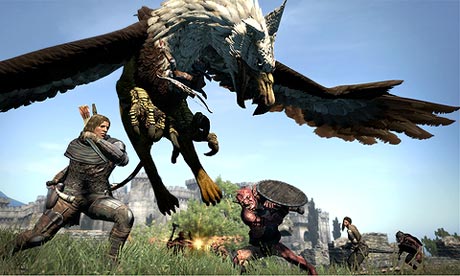
Dragon's Dogma ... yes, it's got griffyns in it too
Japanese publishers have always inspired a cult following among gamers in the know – and perhaps none more so than Capcom. Known primarily in recent years for three franchises – Resident Evil, Street Fighter and Devil May Cry – it has understandably been characterised as a purveyor of action-adventure and beat-'em-up games.
But it's about to enter the competitive but potentially rewarding field of open-world role-playing games with Dragon's Dogma, which conspicuously eschews the typical Japanese RPG blueprint that marries turn-based gameplay with anime-style visuals. Indeed, Dragon's Dogma's real-time action, giant game-world and medieval fantasy setting put one more in mind of the likes of Skyrim, and the ability to climb up bigger adversaries to target your attacks adds a hint of Shadow of the Colossus. We caught up with Dragon's Dogma's producer, Hiroyuki Kobayashi (best known for being a leading light of the Devil May Cry games), on a rare visit to London.
So, Mr Kobayashi, where did Dragon's Dogma – an undoubted departure for Capcom – come from? "First of all, I'm glad you think it doesn't sound like a regular Capcom title. We wanted to try something new, and break into this open-world RPG genre, but of course include all the Capcom elements that we have in a lot of our games. The idea first started off with Hideaki Itsuno, the director of the game, and right around the time when Devil May Cry 4 finished, we started talking about what the next big game we wanted to make would be.
"Itsuno-san really likes the Lord of the Rings series, for example. And when he was in elementary school, he read lots of choose-your-own-adventure books. So that was one inspiration. Another one was going back to the Lord of the Rings, the way that a lot of the fantasy movies are represented – we wanted to create epic battles. There are a lot of games where you fight bosses and hack and slash at their feet, but we wanted to add to that, where you can actually climb onto these enemies and aim for their weak points. So you can climb on a Cyclops and aim for the eye – that kind of stuff. We really wanted to create that realism of being able to take down those giant enemies, just like in the movies.
"In the story, the main character is called the Arisen, and at the beginning of the game, he or she – you can choose – is in a town which a dragon visits, and takes their heart out, rips it out of your chest. So the Arisen becomes more of a hero in this world, and is on a quest to get his or her heart back. A lot of the questions that people have – like why did the dragon take your heart rather than someone else's, or why is it beckoning you to come on and defeat it – these are mysteries that you will figure out as the story progresses."

Not just another RPG

Creating a new open-world RPG franchise undoubtedly makes sense for a publisher like Capcom – such games can be fantastically popular. But they also require huge teams and costly resources, so represent a bit of a punt. It's vital, then, that they sport unique features, and Kobayashi-san singles out the "pawn" system, which lets you assemble a party of fellow-adventurers with complementary skills, via rift-stones in the game: "It is, I think, the first of its kind. A lot of open-world games like this are multiplayer, but we specifically chose to make this a one-player open-world game – with network functions. The pawns are a sort of legion of not-quite-human people: they don't act under their own volition, but they follow. As you play the Arisen, you can command them at your will. There are plenty of pawns you can choose from as your support pawns, and your main pawn will be with you throughout the game. The reason for the existence of the pawns – why are there pawns in this world, and why aren't they human? – will also be answered as you play the game."
The pawns add a hint of multiplayer, or at least community-style gaming, as you can make your favourites available to other players via the game engine, Facebook or Twitter. Kobayashi elaborates: "You can reach the pawn community from the main menu, so you don't have to go through Facebook. It will open up two options: you can either share your main pawn or do a pawn search, which will show all the main pawns that are up on Facebook and Twitter. And you can narrow down your search – look for a Mage, or search by skills and gender. You might find a message from the owner. And if you note their online ID, you can search for that pawn in the rift."
Action-wise, Kobayashi contends that Dragon's Dogma, despite being a first stab at an RPG, preserves the ethos that pervades Capcom's other, more action-focused, franchises: "For example, if you grab onto a gryphon, and the gryphon flies off, as long as you're still holding on, you can continue that battle in the air and bring it down that way. And you can do things like hold an enemy while your pawns attack them. You can grab enemies and throw them off cliffs. That action element, I think, separates Dragon's Dogma from a lot of the other fantasy games."
The levelling-up system, too, is unconventional, placing unusual emphasis on the weight of the objects you collect, and letting you expend XP on upgrading them. Kobayashi explains: "Basically, there are two different ways you can level up your character – by accepting quests and completing them, or by fighting random battles. By, for example, exploring the world, you can find different items and, of course, money; with that you can buy weapons, or upgrade them and level up your character. So if you buy a better sword than you had before, it will raise your strength. Also, each weapon and item of armour can be upgraded up to three stars. So you can make weapons stronger, and make them lighter as well – weight is an important concept in the game, and if you make equipment lighter, you can move a lot more freely."

No shortage of ambition

One of the main joys of open-world RPGs is their sheer scope: the best ones feature giant fantasy worlds in which you can lose yourself for months. And as Kobayashi explains, Capcom hasn't stinted in that regard with Dragon's Dogma: "As far as the world is concerned, it's the biggest map we've created in a Capcom game. If you walk around the coastline of the world, it would take you four to five hours. So it's pretty big. As for the main campaign, it would take an average player around 50 hours to complete, just if you do the main quests. If you do all the sub-quests, it would take easily over 300 hours. It has been in development for about three and a half years now. In-house, we have over 100 people working on it, and out of Capcom, we have about 200 – so it's a very big dev-team."
Kobayashi affirms that, if Dragon's Dogma hits the spot, Capcom is keen to develop it into a franchise in future, and adds: "We do have DLC planned – we will be releasing information about that in the very near future." A demo version of the game will hit Xbox Live Arcade on 24 April and the Sony Entertainment Network on 25 April, so you'll be able to sample it before its release on 25 May. And from what we've seen, while it may come from a hitherto unlikely source, it should launch Capcom as a major player in the RPG world, in competition with the likes of Bethesda and BioWare.

Source:  http://www.guardian.co.uk